


Ask three vendors what it costs to build an AI agent. You will get three wildly different answers. One says $10,000. One says $500,000. One sends you a 40-page proposal that somehow never answers the question. AI agent cost is genuinely hard to pin down, and most vendors have a financial incentive to keep it that way.
I have been on the vendor side of this industry for a long time. Vague pricing gives vendors flexibility. It is not great for buyers.
So here is the honest version. What actually drives the cost of a production AI agent in 2026, what real projects actually run, and what those low-ball quotes are actually buying you.
What Is a Production AI Agent, and Why Does It Cost More Than a Demo?
A production AI agent is not a demo. It is not a proof of concept running on clean sample data in a controlled environment. It is a system that operates in your actual environment, connects to your real data, handles real users, and keeps working when things go wrong.
That distinction is where most of the AI agent cost lives. I have seen developers build something impressive over a weekend. Building something your operations team can trust for the next three years is a completely different project.
What Actually Drives AI Agent Development Cost?
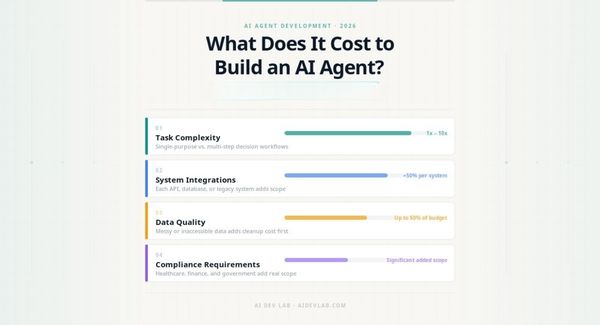
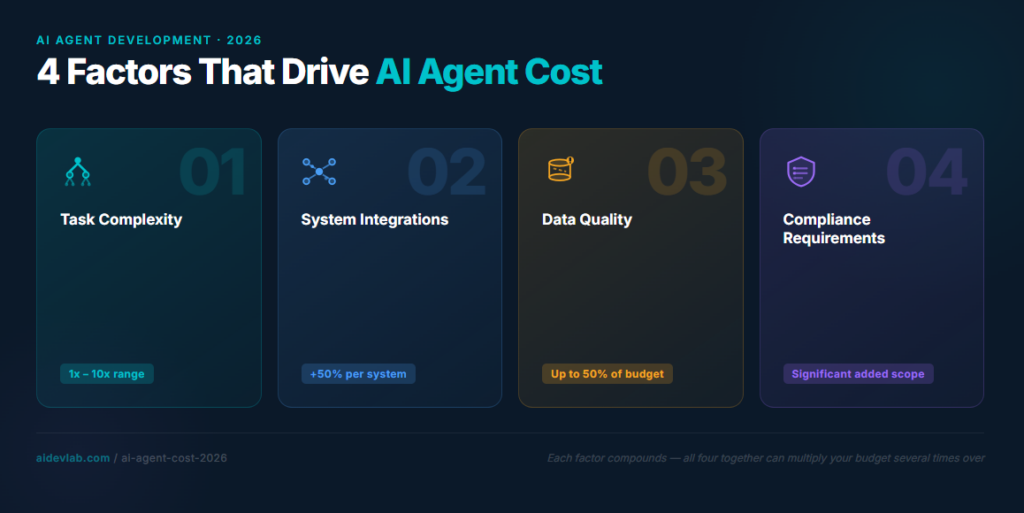
Almost every AI agent budget comes down to four things. Understanding them will tell you more about your likely price than any vendor’s rate card.
1. Complexity of the task
A single-purpose agent that answers questions about one topic costs a fraction of a multi-step agent that pulls customer data, cross-references records, makes a decision, and triggers a downstream workflow. Every additional decision point the agent has to make adds development time, testing time, and risk. The math compounds quickly.
2. How many systems it needs to connect to
Integrations are expensive and slow. Every API, database, or legacy system an agent needs to communicate with is a separate scoping exercise, a separate set of edge cases, and a separate failure mode to plan for. One clean integration is manageable. Five integrations, especially with older systems, can double your timeline before you have written a single line of agent logic.
3. The quality of your data
If your data is clean, structured, and accessible, you are in good shape. If it is scattered across five systems, partially locked in PDFs, inconsistently labeled, or sitting in a database nobody has touched in years, expect a meaningful portion of your budget to go toward data work before any AI gets built. This surprises most clients. It should not. The AI does not fix the data problem. You have to fix it first.
4. Regulatory and compliance requirements
Regulated industries, including healthcare, finance, government, and public transportation, add requirements that simply do not exist in commercial projects. Audit trails, explainability, data residency, security reviews, accessibility compliance. Each one is real scope. If a vendor did not ask about your compliance environment in the first conversation, that is a meaningful red flag.
How Much Does It Cost to Build an AI Agent? Real Ranges by Project Type
“A 2025 study of 372 enterprise organizations found that 80 percent miss their AI infrastructure forecasts by more than 25 percent, and 84 percent report significant margin erosion tied to AI workloads. Most never saw those costs coming.”
These ranges are based on actual projects. Not padded for negotiating room.
What does an AI pilot project cost?
A focused pilot runs $15,000 to $40,000. This is a single-use-case agent built to prove something specific. A customer service bot handling your 20 most common questions. A document summarization tool for one document type. An internal knowledge base agent for a specific team.
What you get: a working system on real but scoped data, limited integrations, and enough operational stability to show results to stakeholders.
What you do not get: production hardening, enterprise security review, full integration with your existing systems, or anything that scales beyond the defined pilot use case.
This tier is right for organizations that need to demonstrate value before committing to a larger build. It is also useful for finding out whether AI actually solves the problem you think it solves, before you spend the money assuming it does.
What does a production-ready AI agent cost?
A fully deployed single agent runs $50,000 to $150,000. It has monitoring, error handling, a feedback loop, and someone accountable for maintaining it. It connects to two to four of your actual systems and has been tested against the edge cases that only show up in real usage.
Most mid-market AI projects land here. The variance within this range comes from integration complexity, data readiness, and how much customization the underlying model requires.
What does a multi-agent system cost?
Multi-agent or complex workflow automation runs $150,000 to $400,000. This is where agents start coordinating with other agents. An intake agent that routes to a processing agent that triggers a downstream workflow. Or a system where different agents handle different inputs and an orchestration layer manages the overall flow.
Complexity compounds at this tier in ways that are not always obvious upfront. You are not just building more agents. You are building the coordination layer that manages them, the fallback logic for when one fails, and the observability tools that let your team understand what is happening inside the system in real time.
What does an enterprise AI platform cost?
Enterprise AI platforms and custom model work run $400,000 and up. Custom model fine-tuning, proprietary data pipelines, enterprise security architecture, dedicated infrastructure, and a sustained engineering team. This tier exists and for the right organization it is absolutely the right investment. Most organizations do not need it and should not be sold it.
What AI Agent Costs Are Missing From Most Proposals?
The purchase price is only part of the picture.
Ongoing maintenance and monitoring. AI systems drift over time. The world changes. Your data changes. A model that performed well six months ago starts giving worse answers without anyone touching it. Budget 15 to 25 percent of your build cost annually for maintenance, monitoring, and updates. This is not optional if you want the system to keep working.
Internal change management. Getting your team to actually use the system. Training, documentation, and workflow redesign. This is not a technology cost, but skipping it is how organizations end up with a $200,000 system that nobody uses eight months after launch.
Data infrastructure. If your data is not ready for AI, you will pay a vendor to get it ready, or you will pay later in poor performance. Either way it is a real cost. Build it into the budget from the beginning.
Before you decide whether to build or buy, it helps to know where your organization actually stands.
Your data maturity, governance gaps, and internal capacity all factor into this decision. If those aren’t clear, even the right framework won’t point you in the right direction.
The AI Readiness Assessment takes five minutes and gives you a scored view across the five dimensions that matter most — including the ones that directly shape this decision.
Take the AI Readiness Assessment →
Before You Call Any Vendor, Answer These Three Questions
If you are early in scoping, here is the most useful thing I can tell you. The difference between a $40,000 AI agent project and a $200,000 one is usually not the AI itself. It is the integrations, the data readiness, and the compliance requirements.
Before you talk to any vendor, get clear on those three things.
- How many systems does the agent need to connect to?
- How clean and accessible is your data?
- What regulatory requirements apply to this use case?
Your answers will tell you more about your likely budget than anything on a vendor’s pricing page. If you want a structured way to think through this, our AI solutions for transit agencies page walks through how we approach scoping for regulated environments specifically.
What Are You Actually Buying With a $5,000 AI Agent Quote?
You will find developers who will build you an AI agent for $5,000 or $8,000. Some will deliver something that works. Most will deliver something that works in a demo and breaks in production, because production hardening, error handling, monitoring, and integration testing are exactly where the real cost lives and where low-end work gets cut.
I am not saying avoid them categorically. I am saying know what you are actually buying. Ask specifically what happens when the agent encounters data it was not trained on. Ask who is responsible for the system after the engagement ends. If you are not sure whether you need a consultant or a dev shop in the first place, we cover the real difference between AI consulting and an AI dev shop, including how to avoid hiring the wrong one.
AI Agent Cost Summary
| Project Type | Typical Range |
|---|---|
| Focused pilot / proof of concept | $15,000 to $40,000 |
| Production single-agent deployment | $50,000 to $150,000 |
| Multi-agent or complex workflow | $150,000 to $400,000 |
| Enterprise platform or custom model | $400,000 and up |
| Annual maintenance (ongoing) | 15 to 25% of build cost |
If you want to figure out where your project lands, I am happy to do a no-obligation scoping call. We will work through the right questions together, give you an honest range, and if we are not the right fit for what you are building, I will tell you that too.
Ready to Find Out What Your AI Project Will Cost?
I do a free 30-minute scoping call. We work through your use case, I give you an honest range, and if we are not the right fit I will tell you that too.
About the Author
Jason Wells is the founder of AI Dev Lab and a fractional Chief AI Officer who helps organizations implement AI that actually works in production. He has developed more than 100 AI products, led technology initiatives across six continents, and spent two decades building technology for public transportation agencies. He holds degrees from Wharton and in applied mathematics and is a four-time Ironman finisher.