


When comparing AI consulting vs AI dev shop options, most buyers do not know which one they actually need. They know they want AI. They just do not know whether to hire a consultant, a development shop, or some combination of the two. The difference is significant, and picking the wrong one is an expensive mistake.
I have operated on both sides of this equation. I have done pure strategy work and I have built production systems. Here is how to think through which one your project actually calls for.
AI Consulting vs AI Dev Shop: What Is the Actual Difference?
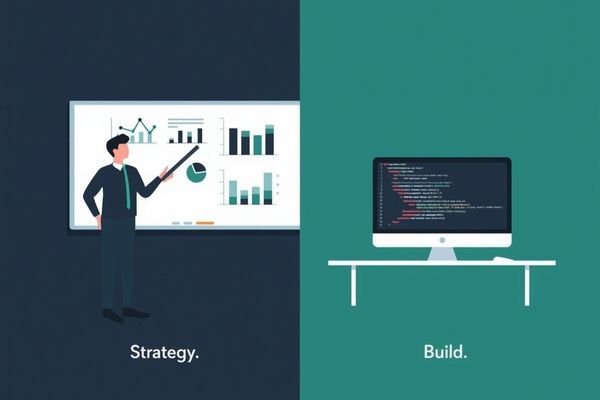
An AI consultant gives you advice. They assess your situation, define a strategy, identify use cases, and hand you a roadmap. The best ones have deep experience and will tell you things you do not want to hear. At the end of an engagement, you have a plan.
An AI dev shop builds things. They take a defined problem and produce a working system. At the end of an engagement, you have software running in your environment.
Neither is better. They solve different problems. The mistake most organizations make is hiring one when they need the other, or hiring one when they actually need both.
When Do You Need an AI Consultant?
You need a consultant when you are still figuring out the question before you can answer it.
Specifically, hire a consultant when:
You have budget allocated to AI but no clear use case yet. If your leadership team has decided that AI is a priority but nobody can agree on what to actually build, a strategic engagement will save you from building the wrong thing at significant cost.
You have competing internal priorities pulling AI in different directions. Different departments want different things. A consultant can run a structured process to figure out where AI will actually move the needle versus where it will be a distraction.
You need to justify an investment to a board or executive team. Consultants are good at producing the frameworks and business cases that get internal approval. That is a real deliverable even if it is not software.
You are in a regulated industry and need to understand the compliance landscape before you build anything. Healthcare, finance, and government environments have constraints that are not obvious until you map them. Getting that wrong costs far more than a consulting engagement.
When Do You Need an AI Dev Shop?
You need a dev shop when the question is answered and the work is ready to start.
Hire a dev shop when:
You know the use case and you need someone to build it. The strategy is done, the problem is defined, and you need a team with actual AI engineering capability to produce a working system.
You have an internal prototype that needs to become a production system. A lot of organizations have something that works in a demo but is not production-hardened, monitored, or integrated with real systems. That is a build problem, not a strategy problem.
You are replacing or augmenting an existing system. You are not asking what to build. You are asking someone to build the thing you have already decided on.
You need ongoing development, not a one-time assessment. Consultants typically engage for a project, deliver a document or roadmap, and exit. If you need a team that will ship, iterate, and maintain a system over time, you need a dev shop.
The Problem With Hiring One When You Need the Other
This happens constantly, and it is expensive in both directions.
Organizations that hire a consultant when they need a dev shop end up with an excellent document and no software. The roadmap sits on a shelf. Nobody builds anything. A year later they are back where they started, except they are now $80,000 lighter and slightly more cynical about AI.
Organizations that hire a dev shop when they need a consultant end up with software that solves the wrong problem. The team builds efficiently and delivers on time. The system works exactly as specified. But the specification was wrong because nobody did the strategic work upfront to figure out what actually needed to be built.
Deloitte’s 2026 State of AI report found that while worker access to AI rose 50%
in 2025, only 34% of organizations are truly reimagining their business with it.
That gap is not a technology problem. It is a sequencing problem.
What About a Hybrid Partner?
A third category exists and it is worth naming. Some firms, including ours, do both. They can help you figure out what to build and then build it. This model has real advantages and one significant risk you should be aware of.
The advantage is continuity. The team that helped define the strategy is the same team that builds it. There is no translation loss between a consulting deliverable and a development specification. The people who know why you made certain decisions are the ones implementing them.
The risk is conflict of interest. A firm that both advises and builds has a financial incentive to recommend building things. You should ask any hybrid partner directly: what would a situation look like where you would tell us not to build anything? If they cannot answer that question clearly, they are not operating as a genuine strategic partner.
We tell clients not to build things fairly regularly. Sometimes the right answer is to buy an off-the-shelf tool. Sometimes the right answer is to fix a process before adding AI to it. We would rather have that conversation early than build something that does not actually solve the problem.
How to Figure Out Which One You Need
Answer these three questions honestly.
Do you know specifically what you want to build? If yes, you probably need a dev shop. If no, you probably need a consultant first.
Has this problem been solved elsewhere in your industry? If similar organizations have deployed similar systems, you are not in uncharted territory. You do not need months of strategic assessment. You need a team that has done this before and can move.
Is your data and infrastructure ready for AI? If you do not know the answer to this question, start with a consultant. Data readiness is the single most common reason AI projects fail after they start building, and catching it before you commit to a development engagement will save you significant money. You can read more about what a production AI agent actually costs and what drives that budget in our earlier post on AI agent cost in 2026.
A Quick Comparison
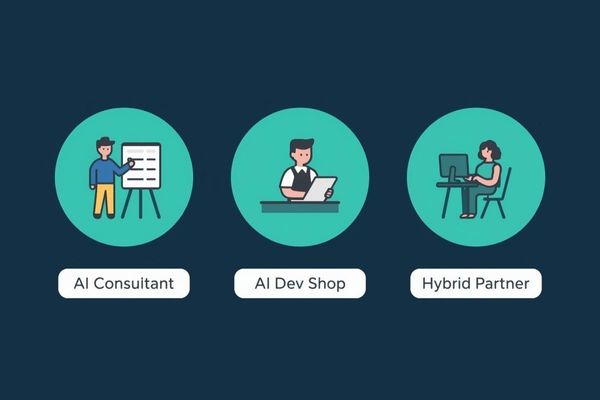
| AI Consultant | AI Dev Shop | Hybrid Partner | |
|---|---|---|---|
| What they deliver | Strategy, roadmap, business case | Working software | Both |
| Who owns the work | You get a document | You get a system | You get both |
| Best for | Pre-build clarity | Defined build | Full-cycle projects |
| Engagement length | Weeks to months | Months to years | Ongoing |
| Watch out for | All advice, no accountability | Builds without strategy | Conflict of interest on scope |
The Bottom Line
The question is not whether to hire an AI consultant or an AI dev shop. The question is where you are in your AI journey.
If you are figuring out the problem, hire strategy help first. If the problem is defined and you need to build, hire a dev shop. If you need both and want a partner who can do the strategic work without padding the development scope, find a hybrid firm that will tell you when not to build.
If you are not sure which category you fall into, that answer is usually: start with a conversation. We do free 30-minute scoping calls. No sales pitch, just an honest assessment of where you are and what kind of help your project actually needs.
Not Sure Which One You Need?
Let’s Figure It Out
I do a free 30-minute call. We talk through your situation, I give you an honest read on whether you need strategy, a build, or both, and if we are not the right fit I will tell you that too.
About the Author
Jason Wells is the founder of AI Dev Lab and a fractional Chief AI Officer who helps organizations implement AI that actually works in production. He has developed more than 20 AI products, led technology initiatives across six continents, and spent two decades building technology for transit and regulated-industry clients. He holds degrees from Wharton and in applied mathematics and is a four-time Ironman finisher.