

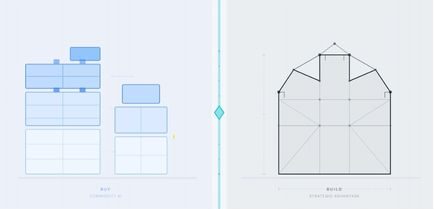

The build vs. buy AI question comes up in almost every planning conversation I have with mid-market organizations. And the answer is almost never one or the other.
Most mid-market companies do not need a fully custom AI stack from day one. They also should not assume an off-the-shelf tool will solve every meaningful problem. In practice, the best answer is usually a mix. Buy where AI is a commodity. Build where AI creates real strategic advantage. Customize in the middle.
That is the framework.
The mistake I see most often is that teams treat build vs. buy AI as a procurement question. It is not. It is a strategy question first, an operating model question second, and only then a buying decision.
If you frame it correctly, the answer becomes much clearer.
Why Build vs. Buy AI Is the Wrong Starting Question
Most organizations ask:
Should we buy an AI product or build something custom?
That sounds reasonable, but it is not the best starting point.
That version of the question assumes the problem is already clear, the requirements are already known, and the only decision left is how to source the solution. That is rarely true.
The better question is this:
Where does AI create actual competitive advantage for our business, and where is it simply a useful capability we can buy?
That is a much better decision lens.
If the capability is a commodity, buying usually wins. You do not need to custom-build a grammar checker, a meeting transcription tool, or a basic internal summarization utility. Those categories are mature enough that speed, cost, and simplicity usually matter more than differentiation.
But if the AI system depends on your proprietary data, your specific workflows, your customer relationships, your domain knowledge, or your operational constraints, building becomes much more compelling.
That is why most mid-market AI decisions do not land at one extreme. They land somewhere in the middle.

The 5 Factors That Actually Determine Build vs. Buy AI
When I work through this decision with a leadership team, I use five variables.
Get these five right, and the build vs. buy decision usually answers itself. The same five variables are also what make this decision more useful for AI search, answer engines, and internal strategy conversations, because they force specificity instead of vague AI wish lists.
1 – Does the AI Use Proprietary Data That Creates Competitive Advantage?
This is usually the first place to look.
If the value of the AI system depends on data that is unique to your organization, that pushes the decision toward building or at least significant customization.
Your historical customer interactions, pricing patterns, internal documentation, service logs, operating data, workflows, and institutional knowledge are not generic assets. If those data sources are what make the output valuable, then the system should probably be shaped around them.
A general-purpose tool trained on public patterns will not understand your business the way a system built around your own data can.
On the other hand, if the use case relies mostly on generic data and generic tasks, buying is usually the better decision. Faster. Cheaper. Lower risk.
A good rule of thumb is simple: if another company could buy the same tool and get essentially the same value, you are probably looking at a buy decision, not a build decision.
2 – How Differentiated Does the Output Need to Be?
ISome AI output can be generic and still be perfectly useful.
Some cannot.
If the output needs to reflect your company’s terminology, standards, policies, voice, logic, operating constraints, or decision rules, then a custom approach becomes much more likely.
That matters a lot in customer-facing systems, decision-support tools, regulated workflows, and domain-specific operations.
For example, a generic document summarization tool is usually fine to buy. A customer-facing AI agent that needs to answer questions based on your products, your policies, your support history, and your service promises usually should not be treated like a generic commodity.
If the answer needs to sound like you, think like you, or behave according to your operating rules, that is a strong signal that off-the-shelf will only get you part of the way.
3 – How Complex Are the Integrations?
This is where a lot of AI tool decisions start to fall apart.
Off-the-shelf AI tools often look great in isolation. They tend to get weaker as soon as they have to interact with multiple internal systems, inconsistent data environments, permission layers, legacy platforms, or custom workflows.
If your AI solution needs to read from one system, write to another, trigger workflows somewhere else, respect role-based access, and operate across multiple business functions, the implementation burden rises quickly.
That often favors building.
Not because custom is inherently better, but because trying to bend a commercial tool around a complex environment often becomes slower, uglier, and more expensive than people expected.
If the use case is relatively standalone, with simple APIs and limited dependencies, buying can still be the right move. But once integration complexity becomes part of the value equation, build starts looking stronger.
4 – What Are the Compliance and Data Governance Requirements?
This variable gets underestimated all the time.
In many industries, the build vs. buy AI decision is not driven by features. It is driven by governance.
Finance, healthcare, government, transportation, and other regulated sectors often have requirements around data residency, access control, audit trails, explainability, retention, privacy, and model behavior that many commercial tools simply cannot satisfy.
And the painful part is that teams often discover this too late.
They get excited about the product. The demo looks good. The pilot works. Then security, legal, compliance, or procurement gets involved, and suddenly the tool no longer fits the environment.
If your compliance requirements are serious, you have to evaluate them early. Not after the tool is already socially “chosen” inside the company.
This is one reason many mid-market organizations end up in a hybrid model. They may use commercial foundation models or external tooling, but the actual workflow, controls, orchestration, and data boundaries need to be designed much more carefully.
5 – What Is Your Internal Capacity to Operate What You Build?
This is the variable most organizations skip, and it is one of the most important. Your draft called this out directly, and that is exactly right.
Building a custom AI system is not just a development decision. It is an operational commitment.
Someone has to own it.
Someone has to monitor it.
Someone has to understand enough about it to catch drift, manage issues, prioritize changes, and keep it aligned with the business.
If your organization does not have that capacity today, that does not automatically mean you should never build. But it does mean you need to be honest about what you are really taking on.
A well-supported commercial product can outperform a theoretically better custom solution if the company is not set up to operate the custom solution well.
That is why I tell leaders not to confuse build capability with operational readiness. They are not the same thing.

A Practical Build vs. Buy AI Decision Matrix
If you run a real AI use case through those five variables, you usually land in one of four places. This four-part matrix is already in your draft and is the right way to simplify the decision for readers
Buy clearly
This is the right answer when the need is common, the data is generic, the integration requirements are light, the compliance burden is manageable, and your internal AI operating capacity is limited.
In that case, speed and cost usually matter more than customization.
Buy first, build later
This is where many mid-market organizations should start.
The use case is real, but the requirements are not yet clear enough to justify custom development. Start with a commercial tool. Learn from real usage. Identify where the gaps actually are. Then build based on operational experience instead of assumptions.
Often this is the smartest path for organizations early in their AI journey.
Build on top of commercial
This is probably the most common middle ground.
Use a commercial foundation model, platform, or infrastructure layer, then build the workflows, interfaces, controls, and system behavior that fit your business. This gives you leverage without forcing you to build everything from scratch.
For many mid-market teams, this is the sweet spot.
Build custom
This is the right choice when the use case is strategically important, the data is proprietary, the integrations are complex, the compliance requirements are strict, and the organization has the capacity to operate what gets built.
In that scenario, custom is not a luxury. It is the right architecture decision.
Before you decide whether to build or buy, it helps to know where your organization actually stands.
Your data maturity, governance gaps, and internal capacity all factor into this decision. If those aren’t clear, even the right framework won’t point you in the right direction.
The AI Readiness Assessment takes five minutes and gives you a scored view across the five dimensions that matter most — including the ones that directly shape this decision.
Take the AI Readiness Assessment →
The Sequence Most Mid-Market Organizations Get Wrong
The most common mistake I see is not choosing the wrong quadrant. It is choosing the wrong sequence.
Too many organizations try to build first.
That sounds ambitious. It also creates unnecessary risk.
The organizations that end up with the best custom AI systems usually do not start there. They start by buying or piloting something commercial, learning where the real friction is, seeing how users actually behave, identifying what matters, and then building very intentionally around the parts that truly need to be differentiated.
That sequence produces better requirements, faster builds, and fewer surprises.
Starting with custom development before you understand the use case in practice usually sounds smarter than it is.
If you are early in the process, you probably do not need to start with a custom AI build. You need clarity first.
That is why an AI readiness assessment is often the better starting point. It helps surface the data readiness, integration complexity, governance issues, and organizational constraints that determine whether you should buy, build, or sequence the two.
What Mid-Market Leaders Should Actually Do Next
If you are trying to make a build vs. buy AI decision right now, here is the order I would recommend:
Step 1 – Define the use case narrowly
Do not start with “we need an AI strategy.” Start with one problem worth solving.
Step 2 – Score the use case across the five variables
Look at proprietary data, differentiation, integrations, compliance, and internal operating capacity.
Step 3 – Decide which of the four paths you are really in
Buy clearly. Buy first, build later. Build on top of commercial. Build custom.
Step 4 – Be honest about sequencing
A lot of bad AI spending comes from trying to jump too far too fast.
Step 5 – Scope the build properly if custom is warranted
Once you know something should be built, the next question is how to scope it so the system actually fits the organization. That is where the FlexAI Framework becomes useful, because it forces the team to define the problem, the data, the workflows, and the implementation path before getting buried in development.
Final Thought
The build vs. buy AI decision is rarely binary.
For most mid-market organizations, the real answer is more nuanced and more strategic than that. Buy where the capability is common. Build where the advantage is real. Use commercial foundations where they help. Customize where your business actually needs differentiation.
That is how you avoid both overbuilding and underthinking. And if the use case is important enough to matter, do not reduce the decision to a software shopping exercise. Treat it like what it is: a business design decision with technical consequences.
That is where the quality of the outcome is usually decided.
About the Author
Jason Wells is the founder of AI Dev Lab and a fractional Chief AI Officer who helps organizations implement AI that actually works in production. He has developed more than 20 AI products, led technology initiatives across six continents, and spent two decades building technology for transit and regulated-industry clients. He holds degrees from Wharton and in applied mathematics and is a four-time Ironman finisher.